

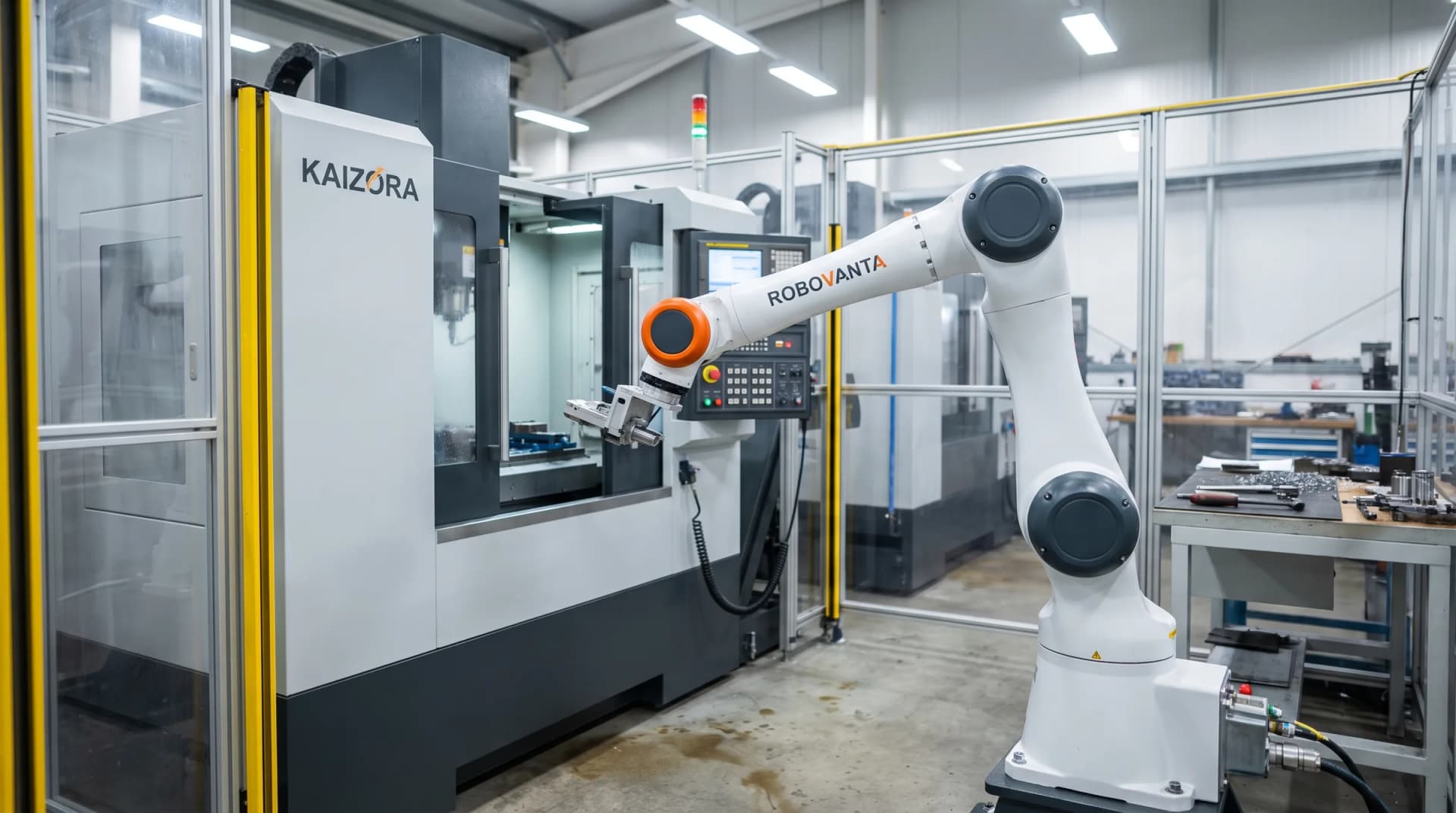
Automating a Machining Cell: Robot Tending vs Pallet Systems
Both extend unattended running hours, but they solve the part-handling problem differently. Here's how to match the automation approach to your actual part mix and fixturing.
Once a shop decides to automate a machining cell for unattended production, the next question is almost always the same: robot tending or a pallet-changing system? Both extend running hours past a single shift, but they solve the problem in different ways, and picking the wrong one for your part mix means paying for automation that doesn't actually fit how your parts move through the shop.
How each approach works
A robot-tending cell, like our Robovanta RV-Tend 12, uses a robotic arm to load and unload parts from a machine's existing fixture, typically drawing from trays or bins staged nearby. The robot handles the part-handling task a human operator would otherwise do, freeing the machine to run through changeovers without a person present.
A pallet-changing system uses multiple fixture pallets that swap in and out of the machine automatically, each pallet pre-loaded (by an operator, ahead of time) with its own workpiece or set of workpieces. Instead of automating the loading motion itself, it automates the fixture swap, letting an operator load pallets during a normal shift for the machine to work through unattended afterward.
Where robot tending wins
Robot tending suits shops with varied part geometry, moderate batch sizes, and parts that fit reasonably within a standard gripper's handling range. Because the robot handles the load/unload motion directly, it adapts more easily to running several different part numbers through the same cell across a shift, provided each one has a compatible fixture already in the machine.
Where pallet systems win
Pallet systems suit shops running larger or more complex fixtures — parts that need multiple operations, unusual clamping, or workholding too large or awkward for a robot gripper to manage cleanly. Because pallets are pre-loaded by a person during a normal shift, they also handle parts requiring careful manual placement or inspection before machining begins, something a robot's simpler grip-and-place motion isn't suited to.
A side-by-side comparison
| Robot Tending | Pallet Changing | |
|---|---|---|
| Best for | Varied parts, standard fixtures, moderate batch size | Large or complex fixtures, multi-op parts |
| Load/unload method | Robotic gripper | Pre-loaded pallet swap |
| Setup flexibility | Good across compatible part families | Excellent for complex, fixed fixturing |
| Typical unattended run length | Limited by tray/bin capacity | Limited by number of pallets available |
| Floor space | Cell footprint around one or two machines | Pallet storage plus machine footprint |
| Relative cost | Lower for a single-machine cell | Higher, scales with pallet count |
Combining both is common
Larger, higher-volume shops often end up using both: pallet systems on machines running complex, high-value parts that justify dedicated fixturing, and robot tending on machines running higher-mix, lower-complexity work where a gripper can handle the variety more economically than a large bank of pallets would. Neither approach is a universal answer, and treating the decision as either/or across an entire shop is itself a common mistake.
Questions to work through first
- What is your actual part mix — a few high-volume parts, or many different ones in smaller batches?
- How complex is your fixturing, and could a standard gripper handle it reliably?
- How many unattended hours are you trying to add per shift, and does your tray or pallet capacity support that?
- Do you have staff available to load pallets during the day shift, or is minimizing operator involvement itself a goal?
Safety and floor layout considerations
Both approaches change how people move around a machine, and both need a deliberate safety plan rather than an afterthought. Robot cells need perimeter guarding and light curtains sized to the robot's actual reach, with interlocks that stop motion the moment a gate opens — retrofitting this after the robot arrives is far more disruptive than planning for it up front. Pallet systems need clear, marked loading zones and enough aisle space for an operator to safely load the next pallet while the machine works through the current one, which can mean rethinking material flow around the cell rather than just around the machine itself.
Plan the cell around the part, not the machine
The single biggest driver of automation success we see is planning fixturing and part flow before selecting hardware, not after. A robot or pallet system bolted onto an existing setup without redesigning the fixture for automated handling rarely performs the way the sales pitch suggested. Our automation team will walk your actual part family through this planning step before recommending either approach — and in some cases, the honest recommendation is to fix fixturing first and revisit automation once that's solved.
FAQ
Common questions
Short answers to the questions we are asked most about this topic.
It depends on tray or bin capacity and part cycle time, but many shops add a full unattended shift, sometimes more, once the cell is tuned and reliable.
Not typically on the same machine at the same time, but a shop can absolutely run pallet systems on some machines and robot tending on others based on each machine's part mix.
Very often, yes. Fixtures designed for manual loading rarely work well with a robotic gripper or automated pallet swap without modification. Planning this before buying the automation hardware is the single biggest factor in a cell actually performing as expected.
No — it also suits moderate-batch, varied-part shops well, provided the parts share a compatible fixture and gripper approach. High-volume single-part production is actually where dedicated fixturing or pallet systems sometimes make more sense.