

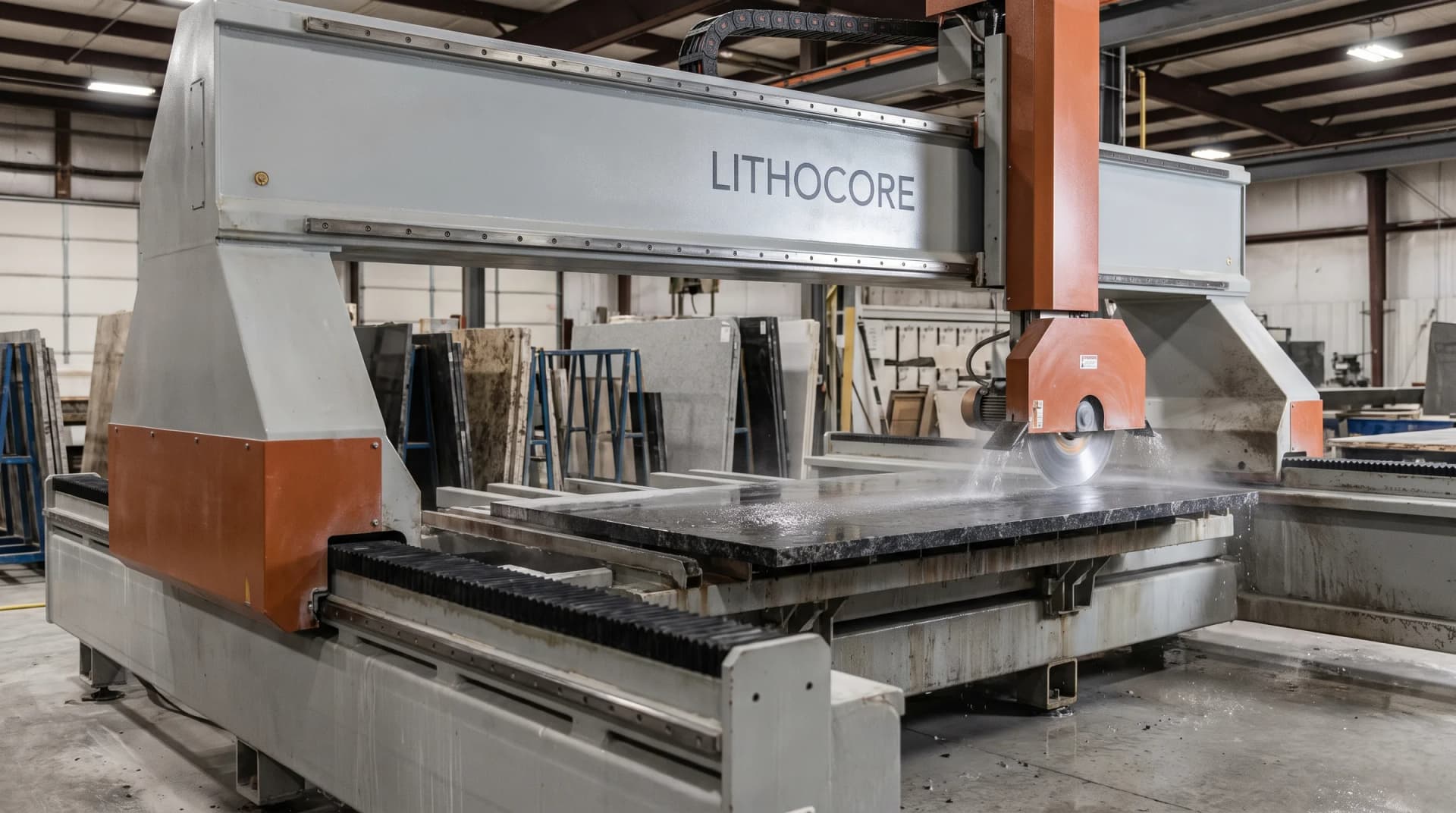
Bridge Saw, Saw-Jet or Waterjet for Countertop Fabrication?
Adding capacity to a countertop shop usually means one of three paths. Here's how to tell which one actually solves your bottleneck instead of duplicating what you already have.
Countertop and slab fabricators usually start with a single bridge saw and, at some point, face the same decision: add a second machine, upgrade to a combination saw-jet, or move to a dedicated waterjet. Each path solves a different bottleneck, and picking the wrong one means paying for capability you don't need while the actual constraint stays unsolved.
What a bridge saw is best at
A bridge saw excels at straight and miter cuts on slabs — the bulk of countertop work in most shops. A rigid, monoblock-base saw like our Lithocore LB-3600 holds accuracy cut after cut on granite, quartz and porcelain, and a motorized miter head handles the 45-degree joints that make up most kitchen edge profiles. What a bridge saw does not do well is curved cutouts, sink and cooktop openings with tight radii, or intricate decorative edge work — those require either a router pass afterward or a different machine entirely.
Where a saw-jet earns its keep
A combination saw-jet pairs a bridge saw's blade with a waterjet head on the same gantry, so a shop can do straight cuts and complex cutouts — sink openings, decorative inlays, radiused corners — without moving the slab between machines. This matters more than it sounds: every slab move is a chance for chipping, breakage or a costly setup error on an expensive piece of material. For a shop doing a steady mix of straight countertop runs and custom cutout work, a saw-jet often replaces what would otherwise be a bridge saw plus a separate waterjet, at a lower combined cost than buying both.
When a dedicated waterjet is the right call
A standalone waterjet, like our Hydravex HX-2040, makes sense when cutout and inlay work is the majority of the workload rather than a supplement to straight cuts — decorative flooring, mosaic work, or shops that also cut metal or glass on the same machine (our cross-listed Hydravex HX5-3060 5-Axis, for example, serves both waterjet-cutting and stone-cnc-centres customers for exactly this reason). A dedicated waterjet also becomes the better choice once volume on complex work outgrows what a shared saw-jet gantry can keep up with.
Comparing the three paths
| Bridge Saw | Saw-Jet Combination | Dedicated Waterjet | |
|---|---|---|---|
| Best for | Straight & miter cuts, high-volume production | Mixed straight cuts + moderate cutout work | Heavy cutout, inlay or multi-material work |
| Slab handling | Single setup per cut type | Single setup for both cut types | Single setup, any shape |
| Relative cost | Lowest | Moderate — replaces two machines | Highest per unit of straight-cut throughput |
| Typical shop profile | High-volume countertop fabricator | Full-service countertop + custom work | Specialty, decorative or multi-material shop |
Questions to answer before you buy
- What share of your jobs need something beyond a straight or mitered cut?
- How much slab handling and re-setup time are you currently losing moving pieces between machines?
- Are you cutting stone exclusively, or does your shop mix in metal, glass or composite work?
- What's your realistic volume on complex cutouts — enough to justify a dedicated machine, or better served by a combination unit?
Our take
Most single-saw shops looking to add capacity are better served by a saw-jet than by a second dedicated bridge saw, simply because it adds capability rather than duplicating what they already have. The exception is high-volume production shops running mostly straight countertop work at scale — for them, a second bridge saw at lower cost per machine often makes more sense than a combination unit they'd underuse.
Don't overlook water and slurry handling
Whichever path you choose, the water and slurry system around the machine deserves as much planning as the machine itself. A saw-jet or waterjet demands more water volume and slurry capacity than a bridge saw alone, and shops that add cutting capability without adding water treatment or slurry settling capacity often find that the new bottleneck is downstream of the machine, not the cutting itself. Factor water reclamation and slurry disposal into your budget from the start rather than discovering the gap after installation.
If you're weighing this decision, walk us through your last twenty jobs — how many were straight cuts versus cutouts versus decorative work — and we can usually tell you within that conversation which path fits. We carry both new and used bridge saws and waterjet systems across our Charlotte and Calgary branches, and a used unit is often the right way to add a second machine without the cost of buying new.
FAQ
Common questions
Short answers to the questions we are asked most about this topic.
Only square or simple rectangular cutouts with a straight blade. Curved or radiused cutouts typically need a router pass or a waterjet head, which is why many shops move to a saw-jet or add a waterjet as they take on more custom work.
Slightly, in most configurations, since the gantry and controls are shared across both cutting methods. For shops with a mixed workload, the time saved by not moving slabs between machines usually outweighs the difference.
Yes — the pump, intensifier and garnet delivery system need more regular attention than a bridge saw's blade and motor, though none of it is unusual for a shop already comfortable with scheduled service intervals.
Yes. Waterjet cutting has no heat-affected zone regardless of material, which is why some models, like our cross-listed Hydravex HX5-3060 5-Axis, serve both metal fabrication and stone fabrication customers.