

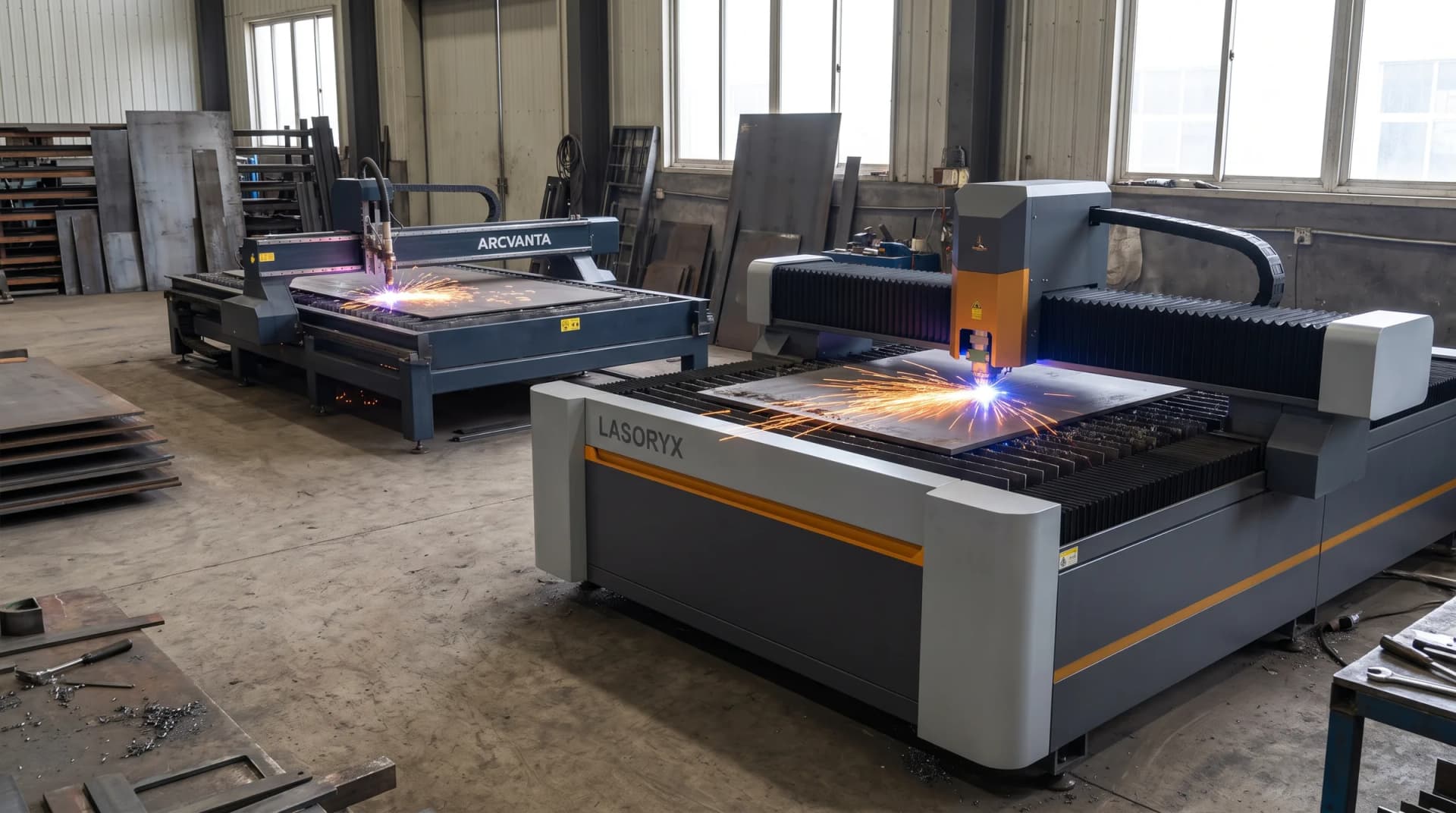
Fiber Laser vs Plasma vs Waterjet: Choosing a Cutting Process
Fiber laser, plasma and waterjet all cut metal, but they get there differently. Here's how to match the process to your material mix, thickness range and tolerance needs instead of guessing.
Every metal fabricator eventually asks the same question: which cutting process actually fits the parts we run? Fiber laser, plasma and waterjet each cut sheet and plate metal, but they get there in different ways, and the "best" one depends entirely on your material mix, thickness range and tolerance requirements — not on which machine looks most impressive on a trade show floor.
How the three processes actually work
A fiber laser focuses a high-power beam through a cutting head to melt and vaporize material along the cut path, assisted by a gas jet (nitrogen, oxygen or compressed air depending on the material). Plasma cutting ionizes gas into a superheated jet that melts through conductive metal. Waterjet uses a high-pressure stream of water, usually mixed with garnet abrasive, to erode material away with essentially no heat at all.
That last difference — heat — is the one that drives most process decisions.
Where each process wins
Fiber laser is the sharpest, fastest and most accurate of the three on thin-to-medium steel, stainless and aluminum. A modern fiber system like our Lasoryx LX-3015 will comfortably cut mild steel up to roughly 3/4" (19 mm) with a kerf narrow enough that parts often need no secondary finishing. If your shop runs mostly sheet and thin plate with tight tolerances, fiber laser usually wins on cost per part once volume is high enough to justify the machine.
Plasma remains the most economical way to cut thick plate. Above about 1" (25 mm), plasma tables close the gap on fiber laser's speed advantage and cost meaningfully less per machine and per consumable. Plasma also tolerates a rougher shop environment — mill scale, rust and uneven material thickness — better than a laser does. If your work is structural steel, heavy equipment fabrication or anything routinely above 1", plasma is worth serious consideration even where a laser could technically make the cut.
Waterjet is the only one of the three with no heat-affected zone, which matters for two very different reasons. First, it can cut materials a laser or plasma simply cannot touch — stone, glass, composites, hardened tool steel — which is why the same underlying technology (as on our Hydravex HX-2040) shows up in both metal fabrication shops and stone fabrication. Second, on metals where heat distortion or hardening at the cut edge is unacceptable — thick stainless, titanium, tool steel that will be hardened later — waterjet avoids a problem the other two processes create by definition.
A side-by-side comparison
| Fiber Laser | Plasma | Waterjet | |
|---|---|---|---|
| Best material thickness | Thin to ~3/4" (19 mm) | ~1/4" to 2"+ (6-50+ mm) | Any thickness, any hardness |
| Heat-affected zone | Small | Larger | None |
| Cut edge quality | Excellent, often finish-ready | Good, may need dressing | Excellent, no hardening |
| Operating cost per hour | Moderate (gas, consumables) | Lowest | Highest (abrasive, pump wear) |
| Materials handled | Conductive metals only | Conductive metals only | Metal, stone, glass, composites |
| Typical shop profile | Sheet metal job shops, OEM production | Structural steel, heavy fabrication | Multi-material, tight tolerance, thick or hardened parts |
Questions worth asking before you decide
A few practical questions cut through most of the process debate faster than a spec sheet comparison ever will:
- What is the thickest and thinnest material you run in the same week? A shop with a wide range sometimes ends up running two processes rather than compromising on one.
- Does your work require a truly heat-free edge, or is a small heat-affected zone acceptable after your normal finishing steps?
- What is your realistic monthly cutting volume? Fiber laser's speed advantage only pays for the machine at real throughput.
- Are you cutting only metal, or does your product mix ever call for stone, glass or composite parts on the same floor?
Our recommendation approach
When a shop calls us undecided between these three, we start with material and thickness range, not budget, because the physics rules out options before price ever should. From there we look at monthly volume, edge-quality requirements and floor space, and we're honest when a shop's actual mix points toward a smaller machine than the one they walked in asking about. A fiber laser sized for occasional thick plate, or a plasma table asked to hold laser-grade tolerance on thin sheet, both end up as expensive disappointments.
If you are somewhere in the middle of this decision, bring us your actual part drawings and a rough monthly volume. Our applications team can usually narrow three options down to one in a single conversation, and if a used machine fits your budget better than new, we carry pre-owned Lasoryx, Arcvanta and Hydravex equipment across our branches worth a look before you commit to new.
FAQ
Common questions
Short answers to the questions we are asked most about this topic.
Not really. Waterjet is the most versatile of the three by material type, but it is also the slowest and most expensive per hour to run on straightforward metal cutting, so shops that cut mostly metal usually still want a laser or plasma table alongside it rather than instead of it.
Plasma generally has the lowest cost per cutting hour, since consumables are inexpensive relative to laser optics and waterjet abrasive. Fiber laser has the best cost per part at high volume on thinner material because of its cutting speed.
Yes, on the material ranges where both can cut. A fiber laser produces a narrower kerf and straighter edge than plasma. The gap narrows on thicker plate, where plasma's speed advantage starts to offset its rougher edge.
Usually not, unless you routinely need a truly heat-free edge on thick or hardened material. Most steel-only shops are better served by fiber laser, plasma, or both.