

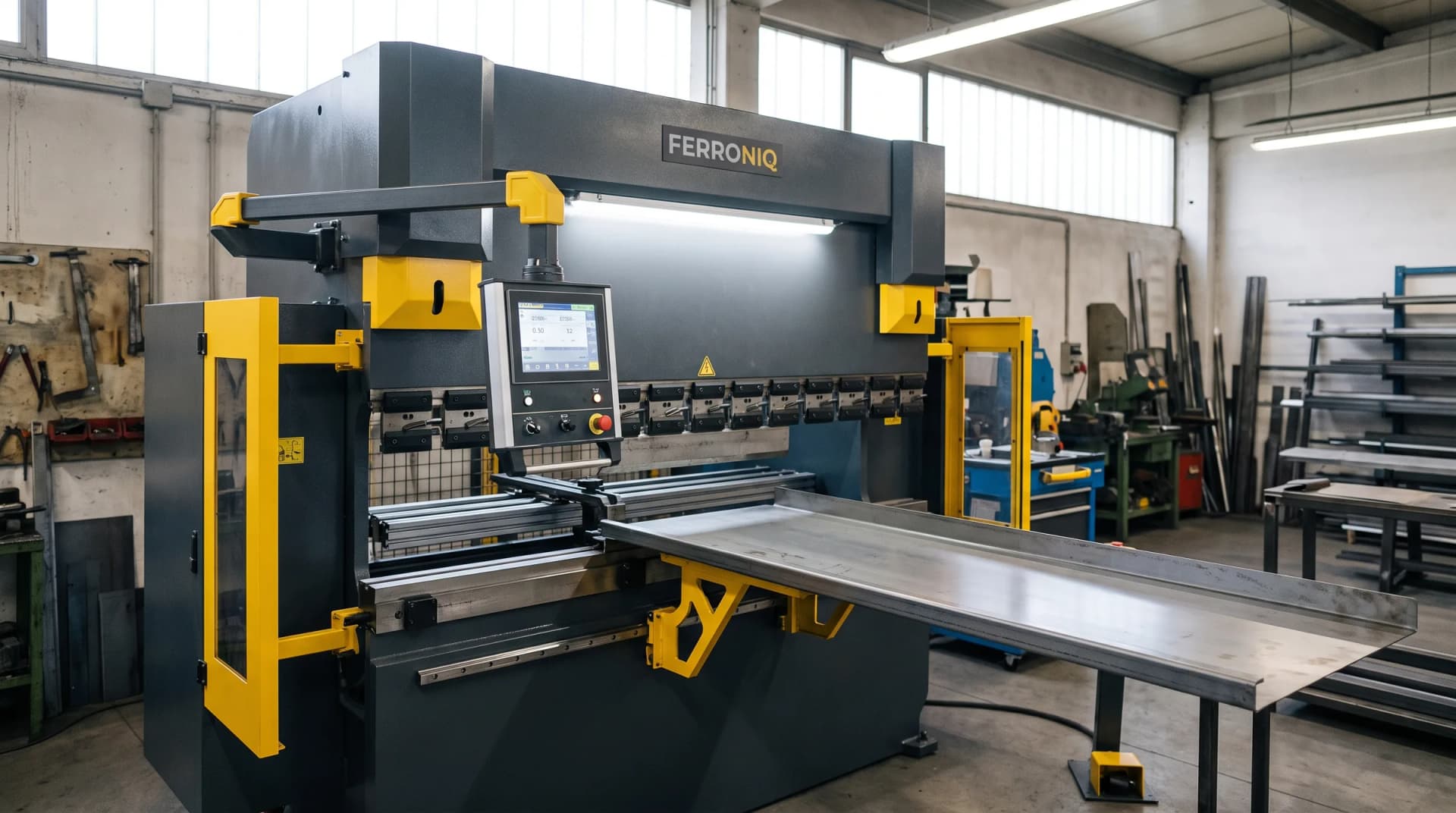
Press Brake Tonnage: How to Size a Brake for Your Parts
Undersizing a press brake shows up gradually, in bowed parts and premature tooling wear. Here's how tonnage, bend length and die opening actually interact — and a worked example.
Undersizing a press brake is one of the most common — and most expensive — mistakes a fabrication shop makes, because the consequences show up gradually: bowed parts, premature tooling wear, and a machine that struggles on exactly the jobs it was bought to handle. Sizing tonnage correctly up front costs nothing extra and saves years of frustration.
The basic tonnage formula
Bending force depends on material thickness, bend length and material type, following roughly this relationship for air bending:
Tonnage (per foot) ≈ (material thickness² × a material factor) ÷ die opening width
Steel needs roughly 500 tons per square inch of cross-section resistance in this formula's units; aluminum needs less, roughly a third of steel's factor; stainless steel needs more, often 25-40% above mild steel depending on grade. This is why a brake sized correctly for mild steel can still struggle with stainless of the same thickness — the material factor, not just the thickness, drives the calculation.
Why bend length matters as much as thickness
A common sizing mistake is calculating tonnage per inch and forgetting to multiply by the actual bend length. A 10-gauge mild steel bend that needs roughly 40 tons per foot requires 400 tons of total force across a 10-foot bend length — a very different number than the "per foot" figure alone suggests. Always calculate tonnage for your longest realistic bend length, not your average one, because that longest bend is the one that will reveal an undersized machine.
Die opening width and bend radius
Wider die openings reduce required tonnage but increase the minimum inside bend radius and can affect part flatness on thin material. Narrower openings tighten the radius but demand more force. If your parts have tight-radius requirements as a design constraint, size the machine's tonnage around the die opening that radius demands, not the other way around.
A worked example
Consider a shop bending 3/16" (4.76 mm) mild steel across a 10-foot bend, using a standard 1.5" die opening:
| Input | Value |
|---|---|
| Material | Mild steel, 3/16" (4.76 mm) |
| Bend length | 10 ft (3.05 m) |
| Die opening | 1.5" (38 mm) |
| Approx. tonnage required | ~55 tons/ft × 10 ft = 550 tons |
That is a genuinely large brake for what sounds like a modest job — which is exactly the kind of surprise that catches shops out when they size on thickness alone and forget bend length. A shop that only occasionally runs a bend this long is often better served renting the capacity or subcontracting it than buying a 550-ton machine for infrequent use.
Don't forget back gauge and future capacity
Tonnage gets the attention, but back gauge accuracy and axis count matter just as much for part quality and repeatability, particularly on complex multi-bend parts. And because a press brake is a long-lived capital purchase, size tonnage with some margin for the heaviest job you can reasonably expect in the next five years, not just your current part mix — buying exactly to today's needs is how shops end up back in the market for a bigger brake sooner than planned.
A sizing checklist
- Calculate tonnage using your longest realistic bend length, not an average
- Confirm the material factor for every material you actually run, not just mild steel
- Match die opening to your tightest bend-radius requirement
- Add reasonable margin for future part growth, not just today's job list
- Confirm back gauge axis count matches your part complexity
Air bending, bottoming and coining
The tonnage formula above assumes standard air bending, the method most shops use for the majority of parts because it needs less force and works across a range of angles with the same tooling. Bottoming and coining — pressing the material fully into the die to improve accuracy and reduce springback — require substantially more tonnage for the same material and thickness, sometimes several times as much. If your parts demand the tighter tolerances bottoming or coining provide, size the machine for that method specifically rather than assuming your air-bending calculation covers it.
Get it checked before you buy
Tonnage sizing has enough variables — material grade, die selection, bend length, future growth — that a quick calculation on paper is a starting point, not a final answer. Bring us your heaviest, longest bend and we'll size a Ferroniq press brake correctly the first time, whether that's a compact 135-ton machine or a larger tandem configuration for wide panel work.
FAQ
Common questions
Short answers to the questions we are asked most about this topic.
Yes, typically 25-40% more depending on grade and temper. Sizing a brake for mild steel and assuming it will handle stainless of the same thickness is a common and costly miscalculation.
Size for your heaviest realistic bend — longest length and thickest material you actually run, with some margin for growth. A brake sized to the average will struggle on exactly the jobs where capacity matters most.
Yes. A wider die opening reduces the tonnage needed for a given bend but increases the minimum inside radius. Size the die opening to your tightest radius requirement first, then confirm tonnage around that.
Servo-electric brakes generally offer tighter repeatability and faster cycle times, though well-maintained hydraulic brakes remain accurate and capable for most shops. The right choice depends more on your cycle-time needs and duty cycle than on accuracy alone.