

When Does 5-Axis Machining Pay Off?
The extra two axes cost real money. Here's how to tell whether your parts actually need simultaneous 5-axis capability, or whether the real payback is in 3+2 setup reduction.
Five-axis machining centres cost significantly more than a comparable 3-axis or 3+2 machine, and the extra two axes of motion only pay for themselves under specific conditions. Understanding those conditions before you buy is the difference between a machine that transforms your shop's capability and one that sits underused while you keep programming everything in 3+2 anyway.
What "5-axis" actually buys you
There are two distinct capabilities that get lumped together under "5-axis," and they matter for very different reasons.
Simultaneous 5-axis moves all five axes together during a cut, which is what you need for complex curved surfaces — impeller blades, turbine components, and organic aerospace shapes where a straight tool path simply cannot follow the geometry. This is the harder capability to justify economically, because it requires the most sophisticated programming and the most expensive machine tolerance.
3+2 (positional) machining uses the extra axes to orient the part, then cuts with the same straight-line moves as a 3-axis machine. This is where most shops actually see their 5-axis payoff: fewer setups, fewer fixtures, and single-setup machining of parts that would otherwise need to be flipped and re-referenced two or three times on a 3-axis machine.
The setup-reduction case
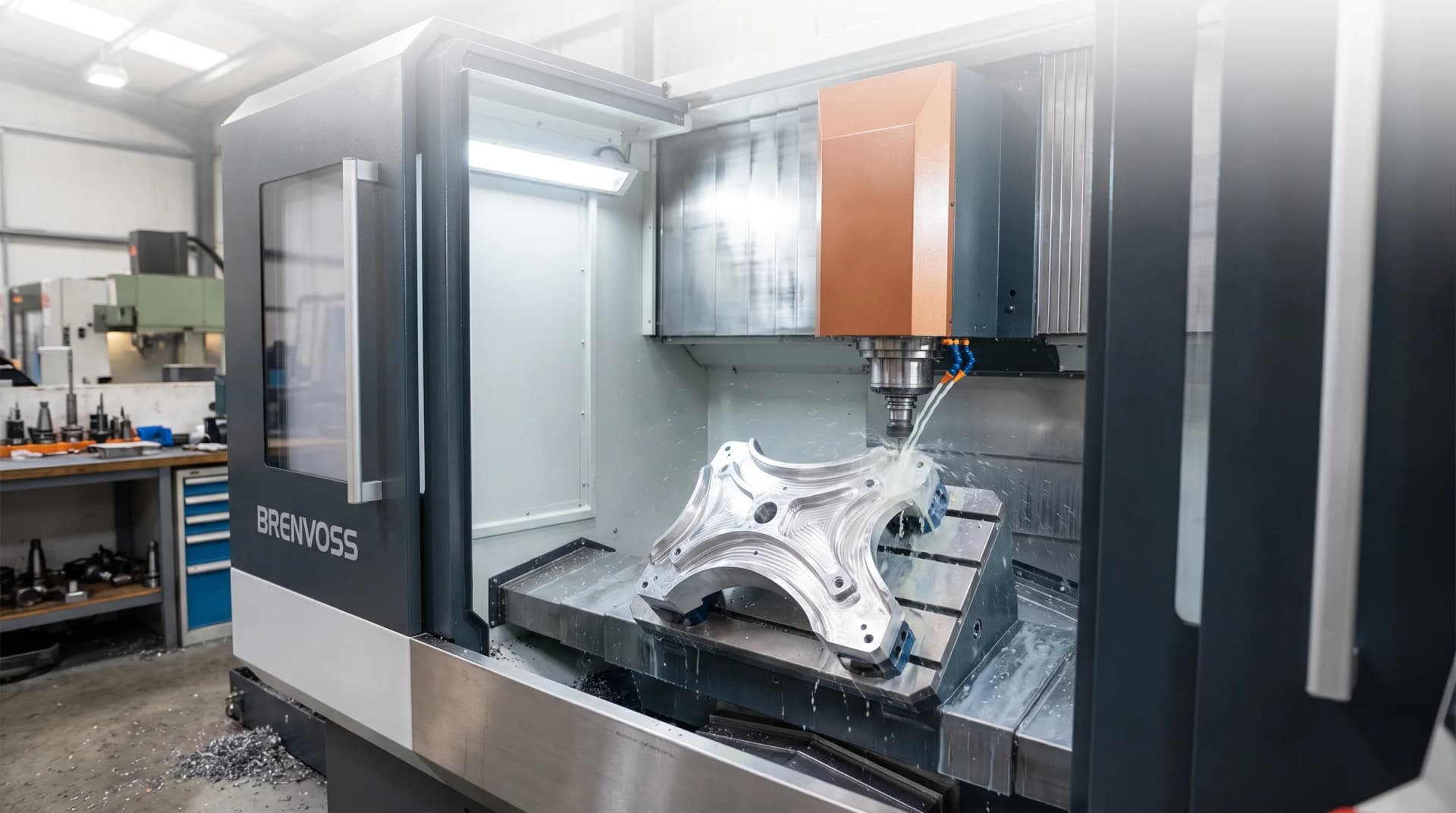
For a huge share of shops, the real payback has nothing to do with complex curves. A part that needs machining on four faces might take three separate setups on a 3-axis VMC, each one adding fixturing time and each one adding a location error that stacks up across the part. A 5-axis machine like our Brenvoss BX5-650 can often machine all four faces in a single setup, eliminating both the added labor and the accumulated tolerance stack-up. If your shop routinely fixtures parts multiple times to reach different faces, this alone can justify the machine on labor savings before you ever program a simultaneous curved surface.
When 5-axis does not pay off
If your parts are genuinely simple — flat, two-sided, or already efficient on a single 3-axis setup — a 5-axis machine adds cost and programming complexity without a matching return. The same is true for shops running high volumes of nearly identical simple parts, where a dedicated fixture on a 3-axis machine, or a pallet-fed cell, will usually out-produce a 5-axis machine on cost per part.
A rough decision framework
Ask these questions before deciding:
- How many separate setups does a typical complex part need on your current machines?
- Do any of your parts have geometry a 3-axis tool path physically cannot reach without an angle change?
- What is your scrap or rework rate tied to fixture re-referencing between setups?
- Is your programming team ready for 5-axis CAM, or does that represent a real training investment first?
- Does your part mix include enough complex work to keep a 5-axis machine busy, or would it sit idle most weeks running simple parts a 3-axis machine could handle just as well?
A quick sizing comparison
| Part characteristic | Best fit |
|---|---|
| Simple, 1-2 sided, high volume | 3-axis VMC, possibly with a pallet system |
| Multi-face, moderate complexity, moderate volume | 3+2 on a 5-axis machine |
| Curved/organic surfaces (aerospace, turbine, medical) | Simultaneous 5-axis |
| Mixed part families, some simple, some complex | 5-axis machine run primarily in 3+2 mode |
Don't forget the programming investment
A 5-axis machine is only as good as the programming behind it. Even for straightforward 3+2 work, programmers need to think in terms of part orientation and collision avoidance in a way a 3-axis toolpath never demands. Budget real training time, and expect the first few complex parts to take longer to program than they eventually will once the team is comfortable — that ramp-up period is normal, not a sign the machine was the wrong choice.
Our recommendation approach
When a shop asks us about moving to 5-axis, we ask to see the actual routing sheets for their five most time-consuming parts before we recommend anything. Setup count and fixturing time almost always tell the real story better than a description of "complex parts" does. In a meaningful number of cases, the honest answer is that a well-tooled 3-axis machine with better fixturing solves the problem at a fraction of the cost — and we'll say so.
If you're weighing this decision, bring your routing sheets to our Vaughan Tech Centre and our applications engineers will walk through where setups could collapse into one, and whether that reduction alone covers the cost difference over a realistic payback period.
FAQ
Common questions
Short answers to the questions we are asked most about this topic.
No. 3+2 uses the two rotary axes to orient the part, then cuts with straight-line 3-axis moves. Simultaneous 5-axis moves all five axes together during the cut itself, which is a different and more demanding capability aimed at complex curved surfaces.
Most modern CAM packages support 5-axis programming, but your programmers may need training even with software you already own, particularly for simultaneous toolpaths. Budget for training time, not just the software licence.
Yes, run in 3+2 or even straightforward 3-axis mode, but a shop running mostly simple parts at volume will usually get better cost per part from a dedicated 3-axis machine or a pallet-fed cell instead.
Buying for a handful of complex parts without checking whether the rest of the part mix will actually keep the machine busy, or without budgeting for the CAM programming learning curve.